Fiber vs 5G Home Internet for Streaming: Which Is Better?
Compare fiber and 5G home internet for live TV by reliability, latency, data policies, installation and total cost.
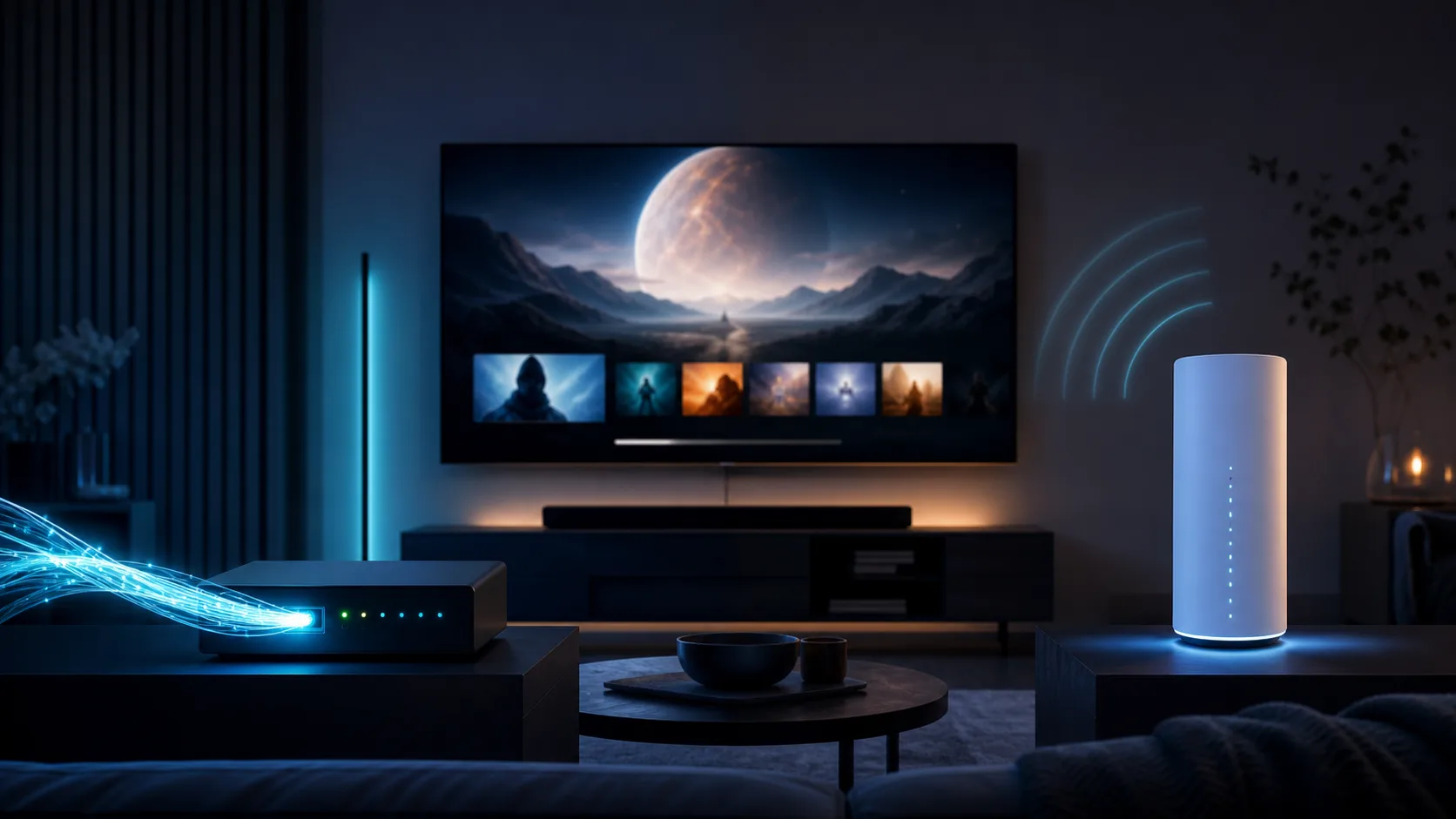
Fiber and 5G home internet can both support live television, but they reach the home in very different ways. Fiber uses a fixed cable connection, while 5G home internet connects through a nearby mobile network. The better option is not simply the plan with the largest advertised download number. For streaming, consistent evening performance, sensible data rules and reliable coverage at your exact address matter more.
Quick comparison
| Factor | Fiber | 5G home internet |
|---|---|---|
| Connection | Dedicated physical line to the property | Fixed wireless link to a mobile network |
| Consistency | Usually less affected by radio conditions | Can vary with signal, placement and tower demand |
| Latency | Often low and predictable | May change as network conditions change |
| Installation | May require an installer and new cabling | Often uses a self-installed indoor gateway |
| Portability | Fixed to the installed address | Service is still normally tied to an approved address |
Consistency matters more than peak speed
A speed test taken once at midday cannot predict every evening. Live video needs bandwidth to remain available continuously; a short fall in throughput can lower picture quality or empty the player's buffer. Fiber is generally insulated from indoor radio interference. A 5G gateway depends on signal quality, building materials, gateway placement and demand on the serving network.
Test at the same location where the gateway will remain, including during busy evening hours. Record several results and watch a long live stream rather than relying on the highest number. Our live TV internet speed guide explains how to measure a connection more realistically.
Latency, jitter and live television
Download capacity controls how much video can arrive, but latency and jitter influence responsiveness and stability. Ordinary streaming can hide some variation with a buffer. Channel changes, live sports, video calls and cloud gaming expose it more clearly. Fiber often provides a steadier baseline, while fixed wireless can still perform well when the signal and local network are healthy.
Check data limits and traffic policies
Read the complete plan terms before choosing either technology. Ask whether the service has a monthly data allowance, a fair-use threshold, video-quality management or reduced priority during congestion. An unlimited label should be checked against the provider's current policy. Estimate your household use with our streaming data calculator guide.
Installation and equipment
Fiber installation may take longer, especially when a building has not been connected before, but the terminal and router can usually be placed in a planned location. A 5G gateway is faster to trial, yet a few meters or a different window can change its signal. Do not hide either router inside a cabinet. If the television is far from the gateway, budget for Ethernet, an access point or a carefully placed mesh system.
Compare the real monthly cost
- Record the promotional price and the standard price after it ends.
- Include installation, activation, router rental and equipment return fees.
- Check contract length, cancellation terms and any price guarantee.
- Confirm whether the quoted speed is a range, a typical value or only a maximum.
- Ask what support will test when performance falls below expectations.
Use the same checklist for every offer. Our home internet plan comparison guide covers contracts and equipment in more detail.
Which connection should you choose?
Choose fiber when it is available at a reasonable complete price and you value stable performance for several simultaneous streams, uploads or remote work. Consider 5G home internet when fiber is unavailable, installation flexibility matters, or the provider offers a low-risk trial with strong measured performance at your address. A good 5G result is better than a poorly maintained wired service, so address-level evidence should decide the purchase.
A practical test before committing
- Place the provider equipment where it will be used permanently.
- Run wired and Wi-Fi tests at quiet and busy times.
- Stream live HD or 4K video for at least 30 minutes.
- Test while another household device downloads or joins a video call.
- Save the plan terms and return deadline before the trial ends.
Frequently asked questions
Is fiber always faster than 5G home internet?
No. Available plans and local conditions vary. Fiber commonly offers more predictable performance, but a well-served 5G address can outperform a slower entry-level wired plan.
Can 5G home internet handle several TV streams?
It can when measured capacity remains high enough during busy hours. Add the expected simultaneous streams and test under real household load before committing.
Does a 5G phone signal guarantee good home internet?
No. The gateway, supported frequencies, indoor placement and provider network policy can differ from a phone. Test the actual home service at the installation address.
Should I keep a backup connection?
A backup may be valuable for remote work or a household that cannot tolerate outages. Compare the cost with your real need; many homes are better served by one reliable connection and a temporary phone hotspot for emergencies.